
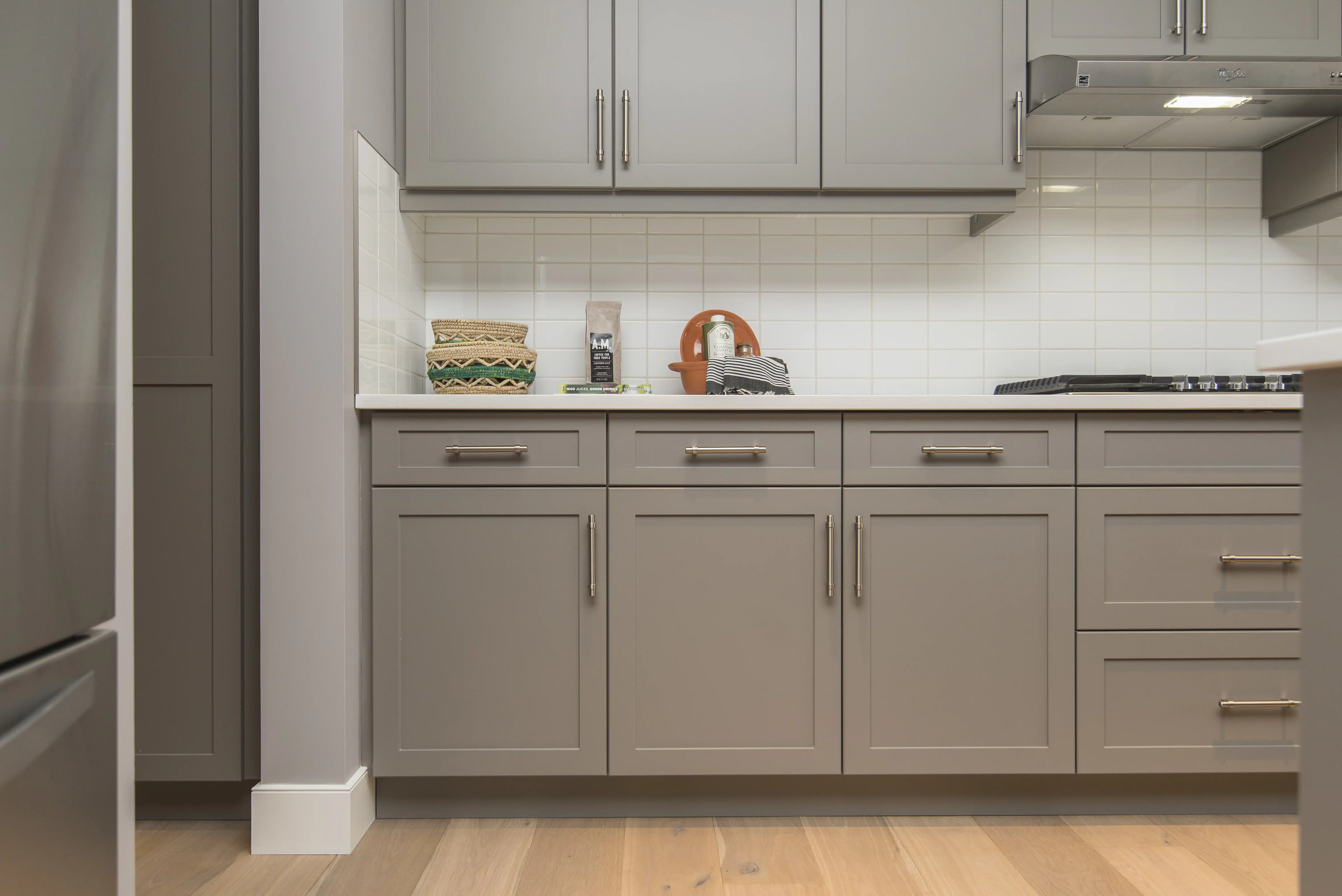
Why cabinets are 30% of your kitchen budget
For a typical mid-range kitchen remodel, cabinets account for somewhere between 28% and 35% of the total cost. That's more than appliances, countertops, and flooring combined. The cabinet decision has the biggest single impact on what you'll spend, how long the project takes, and how the finished kitchen looks for the next 20 years.
The five tiers below cover everything you'll find on the market in 2026. They differ in five things: price, build quality, customization options, lead time, and how they're sold. Understanding those differences is the difference between a kitchen that lasts decades and one that needs replacing in eight years.
| Type | Linear ft installed | Lead time | Best for |
|---|---|---|---|
| Stock | $100–$280 | In stock – 2 wks | Tight budgets, rentals, fast turnaround |
| Semi-custom | $250–$550 | 6–10 weeks | Most homeowners staying 5+ years |
| Custom | $500–$1,200+ | 10–20 weeks | Premium remodels, unusual layouts |
| IKEA (SEKTION) | $110–$220 | In stock – 4 wks | Modern style, design-savvy DIYers |
| RTA online | $90–$200 | 2–6 weeks | DIY assembly, contractor flips |
"Linear foot" means one foot of cabinet measured along the wall. A typical 150-square-foot kitchen has 25–35 linear feet of cabinets. So a stock kitchen at $200/linear foot runs $5,000–$7,000 in cabinets; the same kitchen in custom cabinets at $900/linear foot runs $22,500–$31,500. That gap — almost $25,000 on the same footprint — is why this decision matters.
Stock cabinets
Stock cabinets are pre-built in standard sizes (typically 3-inch increments from 9" to 48" wide) and stocked in warehouses ready to ship. You'll find them at Home Depot, Lowe's, Menards, and through brands like KraftMaid (some lines), American Woodmark, and Hampton Bay.
What you give up
- Sizing flexibility. If your wall is 39 inches wide, you'll either install a 36" cabinet with a 3" filler strip or order custom. Stock doesn't bend.
- Door style and finish range. A stock line might offer 6–10 door styles in 4–6 finishes. Custom lines offer hundreds of combinations.
- Storage features. Pull-out trash bins, spice racks, lazy Susans, and tray dividers are usually limited or unavailable.
What stock cabinets do well
Stock cabinets ship fast — often same day to two weeks — which is enormous when you're trying to compress a remodel timeline. Build quality on the better stock lines (KraftMaid Vantage, American Woodmark) is genuinely good: real plywood boxes, soft-close hinges, dovetail drawers. The very cheapest stock lines use particleboard or thin MDF and staples instead of dowels, which is where stock cabinets earn their bad reputation.
The trick with stock is to avoid the bottom of the line. The price gap between the cheapest and the better stock options is often only $30–$80 per linear foot — but the durability difference is enormous.
Semi-custom cabinets
Semi-custom is where most kitchen remodels land. Brands like KraftMaid, Schrock, Diamond, Thomasville Studio, Decora, and dozens of regional makers all play in this tier. The cabinets are built to order from a defined catalog of sizes, finishes, door styles, and storage features, but you can't draw something on a napkin and have it built.
Concretely, semi-custom typically gives you:
- Sizes in 1/4" or 1/8" increments rather than 3"
- 40–80 door styles, 30–60 finishes
- Real plywood box construction (3/4" sides) on most lines
- Soft-close hinges and full-extension drawer slides standard
- Most of the storage features you've ever seen — pull-outs, trash drawers, appliance garages, drawer-in-drawer setups
- Lead time of 6–10 weeks from order to delivery
Semi-custom is the sweet spot for most homeowners because the gap between semi-custom and full custom in finished appearance is often invisible, while the price gap can be 40–60%. Where semi-custom genuinely falls short is in unusual layouts (angled walls, oversized islands, ceilings over 9 feet) and in matching specific historic styles where every detail needs to be correct.
Custom cabinets
Custom cabinets are built from scratch by a cabinetmaker — either a local shop or a high-end factory line — to exactly your specifications. Expect to work with a designer who produces detailed drawings, select wood species and finishes that may need to be sourced specially, and wait 10–20 weeks from order to delivery.
You're paying for three things at the custom tier:
- True dimensional flexibility. A 41-3/4" cabinet to fit your specific wall, with the door style you sketched, in a custom-mixed finish.
- Construction quality. Mortise-and-tenon face frames, dovetailed drawer boxes, hand-applied finishes with multiple coat-and-sand cycles. The best custom is genuinely heirloom quality.
- Architectural integration. Inset doors with bead detail, hidden hinges, custom moldings that match your home's trim, integrated paneling that conceals a fridge so well you can't tell it's there.
Custom only makes financial sense in two situations: you're staying in the home long-term in a high-value neighborhood where the resale market rewards premium finishes, or your home has architectural quirks (historic trim, unusual ceilings, oddly shaped rooms) that semi-custom can't elegantly handle. For a typical suburban home, custom cabinetry overbuilds the kitchen relative to the rest of the house and won't recoup at resale.
IKEA cabinets (SEKTION)
IKEA's SEKTION cabinet system is its own category. The boxes are particleboard with a melamine interior — which sounds bad but is actually durable, easy to clean, and waterproof in a way solid wood isn't. The doors are sold separately and there are dozens of styles, including IKEA's own and aftermarket options from companies like Semihandmade and Reform that bolt onto SEKTION frames.
SEKTION's strengths:
- Aggressive pricing — typically 30–50% less than semi-custom for similar functionality
- 25-year warranty on the boxes
- Modern Scandinavian aesthetic that fits contemporary homes well
- Excellent storage hardware (BLUM hinges and drawer slides come standard)
- Fast — boxes are stocked at IKEA stores
SEKTION's weaknesses:
- Cabinet sizes are metric and come in fixed widths (15", 18", 24", 30", 36" approximately) — fillers are required to fit imperial-dimensioned walls
- Installation is more complex than traditional face-frame cabinets — most contractors charge a premium to install IKEA
- The IKEA-branded doors look fine but won't match a traditional or transitional aesthetic
- Resale appraisers sometimes value IKEA kitchens lower than semi-custom equivalents, despite functional parity
If you're going modern and your contractor (or you) is comfortable with the IKEA system, this is one of the best price-performance options on the market. Pair SEKTION boxes with Semihandmade or Reform doors and you can get something that looks like a $40,000 kitchen for $15,000.
RTA (ready-to-assemble) cabinets
RTA cabinets ship flat and you (or your contractor) assemble them on site. They're sold mostly online by brands like CliqStudios, RTA Cabinet Store, Cabinets.com, and dozens of direct-from-China resellers.
The quality range in RTA is enormous. The best RTA brands use plywood boxes, soft-close hardware, and dovetailed drawers — basically semi-custom quality at stock prices. The worst use thin particleboard, staples, and Asian hardware that fails within a few years.
RTA works best when:
- You're confident assembling cabinets yourself or have a contractor willing to (most charge $50–$80 per cabinet for assembly)
- Lead time is flexible — boxes can take 2–6 weeks to arrive
- You've ordered a sample door and box from your chosen brand to verify quality before committing
- You're comfortable with limited recourse if a cabinet arrives damaged
Cabinet construction quality: what to actually look for
Marketing language ("solid wood construction!", "all plywood!") obscures more than it reveals. When you're evaluating any cabinet, ask about these specifics:
Box construction
- Plywood vs. particleboard sides: 3/4" plywood is best, 1/2" plywood is acceptable, particleboard is fine in IKEA-style melamine systems but problematic in traditional cabinets where moisture will swell it.
- Joinery: Dado joints (a slot cut for the panel to fit into) are stronger than simple butt joints. Dowels and screws are stronger than staples.
- Back panel: A 1/4" plywood back is minimum. Some cheap cabinets use 1/8" hardboard or skip the back entirely with just a hanging strip — these wobble over time.
Drawer boxes
- Solid wood with dovetail joints is the best — typical of custom, top-tier semi-custom, and good RTA
- Plywood with dadoed joints is acceptable on stock and lower semi-custom
- Particleboard or stapled boxes are cheap-only and will fail under load within years
Door construction
- Solid wood rails and stiles with a wood or veneered MDF center panel is the standard for painted doors
- MDF doors are dimensionally stable and don't crack like solid wood, which makes them actually preferred for high-quality painted finishes (custom shops use both)
- Thermofoil is a vinyl coating fused to MDF — fine for budget kitchens but can peel near heat sources after 5–10 years
Wood species and door styles
Wood selection affects both durability and the kitchen's feel. The four most common species in 2026 cabinets:
- Maple — dense, smooth grain, takes paint and stain evenly. The most popular kitchen cabinet wood. Good for any style.
- Oak — strong and durable with prominent grain. Quartersawn white oak has had a major comeback in 2024–2026 thanks to its modern look.
- Cherry — naturally darkens over time (a feature, not a bug). Traditional, warm, expensive.
- Walnut — darkest, richest, most expensive. Increasingly popular in modern and transitional kitchens.
Door styles that have aged well: Shaker (the safest choice — modern enough for contemporary, traditional enough for classic homes), slab (modern, minimalist), and inset Shaker with bead detail (transitional traditional). Door styles trending hard in 2026: vertical reeded panels, fluted slabs, and arched-cope glass doors on uppers.
Hardware: hinges, drawer slides, and pulls
This is where cheap cabinets fail first. Hinges and drawer slides see thousands of cycles per year — bad ones loosen, sag, and squeak within a year or two. The good news: hardware is buyable separately and easy to upgrade.
The two brands worth knowing:
- BLUM (Austrian) — the gold standard. Soft-close everything, easy to adjust, lifetime warranty. Used by good semi-custom and IKEA.
- Grass (German/American) — second gold standard. Comparable quality, slightly different aesthetic. Used by many semi-custom and custom lines.
Avoid generic "soft-close hinges" without a brand attached. They're usually short-lived knockoffs.
How to choose the right tier for your project
A simple decision framework:
- How long will you live here? Less than 5 years: stock or IKEA. 5–15 years: semi-custom. 15+ years or forever home: semi-custom or custom.
- What's your home's price point? The kitchen should match the home's tier within ~10%. A $60k kitchen in a $300k home is overbuilt and won't recoup.
- Are there architectural quirks? Angled walls, 10-foot ceilings, historic trim, unusual layouts — these push you toward semi-custom or custom. Standard 8-foot ceilings with rectangular layouts work fine in any tier.
- How time-sensitive is this? Need cabinets in less than 6 weeks: stock, IKEA, or fast RTA. Have time: semi-custom or custom.
- What's your DIY tolerance? Comfortable assembling: IKEA or RTA saves money. Want hands-off: stock through professional install or semi-custom is easier.
For most readers, the answer ends up being semi-custom in the $300–$450/linear foot range from a regional brand. That tier balances quality, customization, and cost for the typical 7–15 year ownership window most people are planning around.
See what cabinets cost in your kitchen
Use the calculator to see how cabinet tier choice affects your total kitchen remodel budget — and how it compares to other categories.
Open the calculator